Dr. Jekyll's will
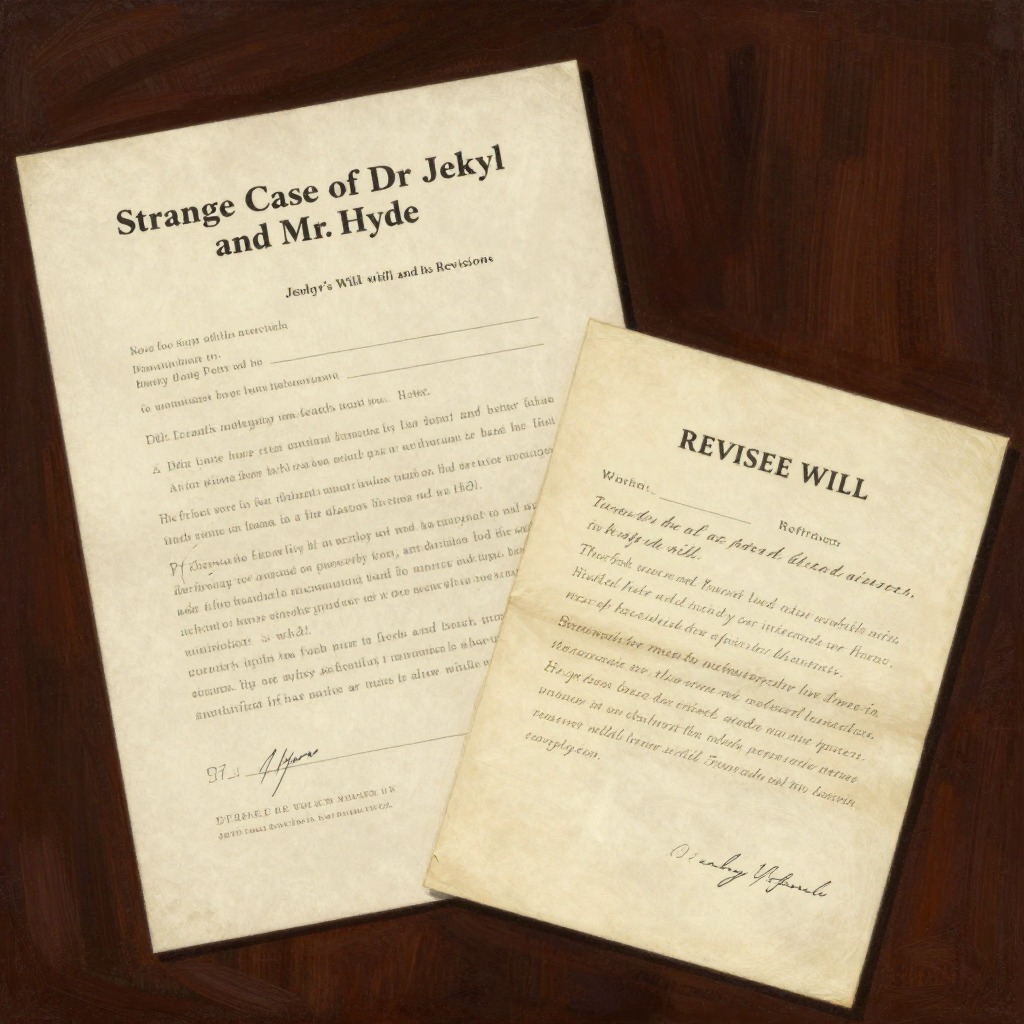
Dr. Jekyll's will is the legal instrument through which the strange and sinister relationship between Henry Jekyll and Edward Hyde first becomes known to the outside world, and it remains a key piece of evidence as the mystery deepens. The document is holograph, drawn up by Jekyll himself without the assistance of his lawyer, Mr. Utterson, who refused to lend any help in its making. It provides not only that, in case of the decease of Henry Jekyll, all his possessions pass into the hands of his "friend and benefactor Edward Hyde," but also that in case of Jekyll's "disappearance or unexplained absence for any period exceeding three calendar months," Hyde should step into Jekyll's shoes without further delay, free from any burden or obligation beyond the payment of a few small sums to the doctor's household. This clause, which treats disappearance as equivalent to death, is what makes the will so deeply troubling to Utterson, who calls it his "eyesore" and finds it offensive both as a lawyer and as a lover of the sane and customary sides of life.
Utterson's Reaction and the Will's Significance
When Utterson first studies the will after hearing Enfield's story of the child trampling, he is already disturbed by the name of Hyde, but now that name is "clothed upon with detestable attributes." He reflects that he had thought the will was madness, but now he begins to fear it is disgrace. The will thus becomes the focal point of Utterson's anxiety about his friend Jekyll, and it drives him to seek out Lanyon for information. Later, when Utterson confronts Jekyll directly about the will, the doctor's face grows pale and he becomes evasive, saying that his position is "a very strange one" and that the matter cannot be mended by talking. Utterson presses further, and Jekyll admits that it was Hyde who dictated the terms of the will concerning the disappearance clause. Utterson immediately interprets this as evidence that Hyde meant to murder Jekyll, telling him, "You had a fine escape."
The Will's Transformation and Final Appearance
After Lanyon's death, Utterson discovers that Lanyon's sealed envelope contains a reference to the same idea of disappearance, bracketed with the name of Henry Jekyll, which had originally appeared in the will under Hyde's sinister suggestion. This parallel deepens Utterson's unease. In the final chapter, when Utterson and Poole break into the cabinet, they find a new will, drawn in the same eccentric terms as the one Utterson had returned six months before, but with one shocking difference: in place of the name of Edward Hyde, the lawyer reads the name of Gabriel John Utterson. Utterson is stunned, realizing that Hyde had been in possession of the cabinet for days and had not destroyed this document, despite having no cause to like him. The will thus serves as a final, ironic testament to Jekyll's desperate hope that someone else might inherit his burden, even as Hyde's suicide renders the document moot.